

The fastest way to confirm a garage door company is licensed and insured before scheduling garage door repair is to ask directly for the license number and insurance carrier, then verify both independently instead of taking their word for it. A company that hesitates to hand over either piece of information is telling you something before any work even starts.
Below are five concrete ways to verify a garage door company’s license and insurance status, so you’re not relying on a sticker on a truck or a line on a website. Licensing and insurance are two of the items worth checking first when vetting any garage door company, since they protect you legally and financially if anything goes wrong. Unlike reviews or pricing, which can involve some subjective judgment, license and insurance status are simple yes-or-no facts you can confirm independently in a few minutes, which makes them the easiest place to start.
Key Takeaways
- Ask for the license number and insurance carrier name directly, before discussing price.
- Most states let you verify a contractor’s license online in under a minute.
- A quick call to the insurance carrier confirms the policy is actually active, not expired.
- A legitimate company puts license and insurance details on invoices, not just on a truck decal.
- BBB accreditation is a useful secondary check, but it isn’t a substitute for verifying the license itself.
- None of these checks require confronting the company directly. They can all be done quietly, on your own time, before you ever pick up the phone to schedule.
Verification Method vs. What It Confirms
| Verification Step | What It Confirms | Red Flag If |
| Ask for the license number | The company has one to give | They dodge the question or won’t provide a number |
| Search the state licensing board | The license is real and active | No match, or license is expired/suspended |
| Call the insurance carrier | Coverage is currently in force | Carrier can’t confirm, or policy lapsed |
| Check invoices and vehicles | License/insurance info is displayed consistently | No license number anywhere on paperwork |
| Check BBB accreditation | A secondary layer of vetting | No BBB profile despite years in business claims |
1. Ask for the License Number Directly
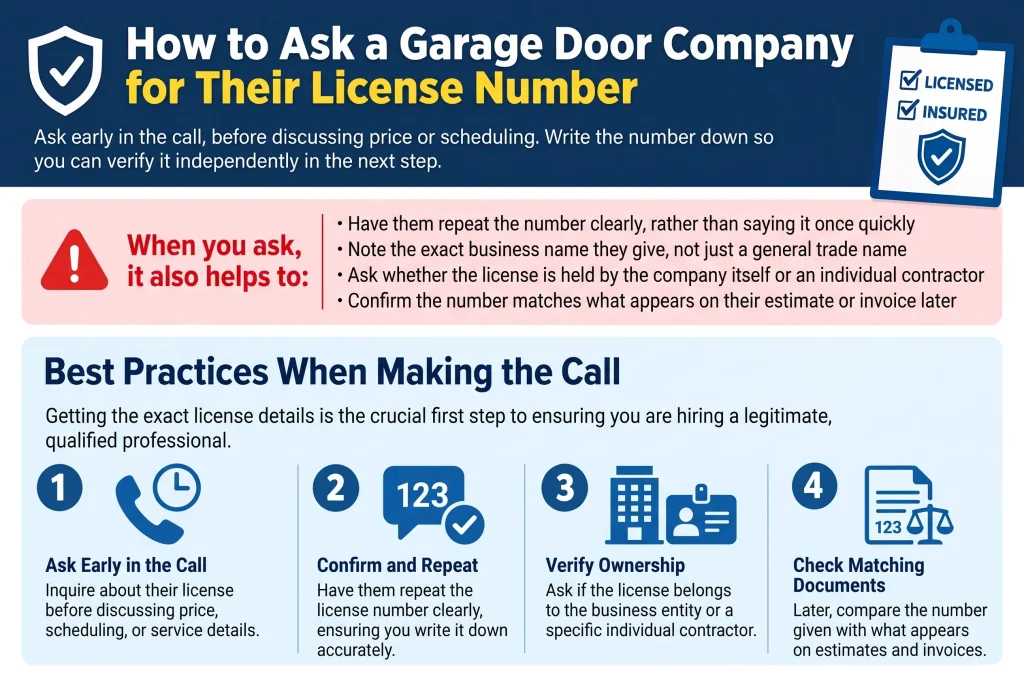
This is the simplest step and the one most homeowners skip. A licensed company should be able to give you the number immediately, without checking with someone else first.
Red flag if: They say “we’re licensed” but stall when asked for the actual number, or give you a number that doesn’t match the business name.
How to Ask a Garage Door Company for Their License Number
Ask early in the call, before discussing price or scheduling. Write the number down so you can verify it independently in the next step.
When you ask, it also helps to:
- Have them repeat the number clearly, rather than saying it once quickly
- Note the exact business name they give, not just a general trade name
- Ask whether the license is held by the company itself or an individual contractor
- Confirm the number matches what appears on their estimate or invoice later
This is just one piece of a bigger picture, so if you want the full vetting checklist, read How to Choose a Trustworthy Garage Door Company.
2. Search Your State’s Contractor Licensing Board
Most states maintain a free, searchable database of licensed contractors by business name or license number. This takes the company’s claim out of the equation entirely.
Red flag if: The license doesn’t appear in the search, or it shows as expired, suspended, or revoked.
For broader guidance on avoiding unlicensed or fraudulent contractors, the International Door Association’s scam awareness resources cover this in more detail.
Where to Verify a Garage Door Contractor’s License Online
Search your state’s department of labor, licensing, or consumer affairs website. Maryland homeowners can check the Maryland Home Improvement Commission’s contractor license search directly.
When you search, confirm:
- The license status shows as active, not expired or suspended
- The licensed business name matches exactly what you were given over the phone
- The license type covers the specific work being performed
- The license has been active long enough to match any claims about years in business
3. Call the Insurance Carrier to Confirm Active Coverage
A company can genuinely have had insurance at some point and let it lapse. The only way to know for certain is to call the carrier directly and confirm the policy is currently active.
Red flag if: The company won’t name their carrier, or the carrier can’t confirm an active policy under that business name.
What to Ask an Insurance Carrier When Verifying a Contractor’s Coverage
Ask whether the policy is currently active, what type of coverage it is (general liability is the most relevant for property damage), and whether it covers the specific business name on your estimate.
The International Door Association also addresses this directly in its post on garage door scam awareness, which lists insurance verification as a key step homeowners often skip.
It’s also worth confirming:
- The policy’s coverage limits, especially for larger jobs
- Whether the business name on the policy matches your estimate exactly
- Whether workers’ compensation coverage is also in place for technicians
- How long the current policy has been active
Verifying coverage protects you financially in one way, and understanding how pricing works protects you in another, which is exactly why it’s worth reading Why Do Garage Door Repair Quotes Vary So Much Between Companies? 6 Pricing Red Flags to Watch.
4. Check Invoices and Vehicles for Consistent License Information
A company confident in its licensing displays it consistently: on the truck, on the invoice, and on the estimate. Inconsistency or absence across all three is worth noticing. This kind of consistency is easy for a legitimate business to maintain and surprisingly hard for a fly-by-night operation to fake across every touchpoint at once.
Red flag if: The license number on the invoice doesn’t match what you verified with the state, or no license number appears anywhere in the paperwork.
What a Legitimate Garage Door Company’s Paperwork Should Include
A complete invoice or estimate should include:
- The business’s license number
- The business’s legal name (matching what’s on file with the state)
- Contact information that matches what you called to reach them
- A physical business address, not just a phone number or website
5. Check BBB Accreditation as a Secondary Signal
BBB accreditation isn’t a substitute for verifying the license itself, but it adds another layer of vetting, especially for complaint history and how a company has responded to past issues.
Red flag if: A company claims decades in business but has no BBB profile at all, or has an unusually high volume of unresolved complaints.
How to Read a Garage Door Company’s BBB Profile
Look past the letter grade alone. Read a few of the complaint responses to see whether the company addressed issues directly or ignored them.
A useful BBB check includes:
- The overall letter grade, but treated as a starting point rather than the full picture
- How many complaints were filed and over what time period
- Whether the company responded to each complaint directly
- Whether complaints were resolved to the customer’s satisfaction
The same instinct for spotting a curated reputation applies to online reviews too, which we cover in How Can I Tell If Garage Door Company Reviews Are Fake? 5 Warning Signs.
Skipping This Step Costs More Than the Five Minutes It Takes
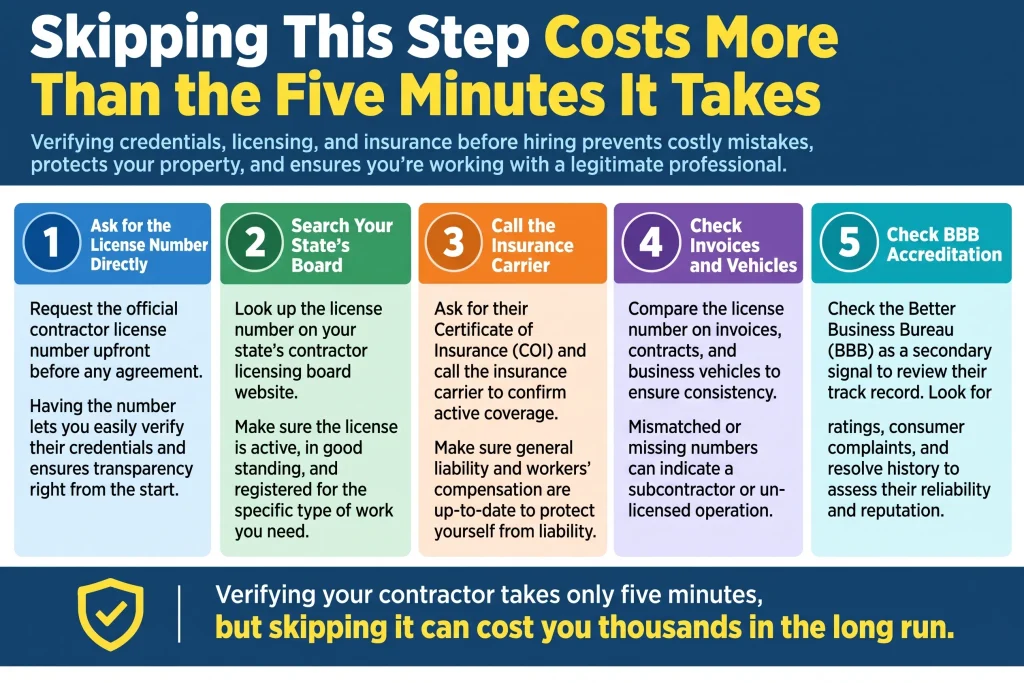
None of these five checks takes more than a phone call or a quick search, and together they take maybe five minutes total. That’s a small trade for knowing the company doing work in your garage is actually covered if something goes wrong. Homeowners who skip this step usually don’t regret it, right up until something does go wrong, at which point an uninsured or unlicensed company becomes a much bigger problem than the original repair ever was.
All About Doors is a licensed and insured garage door company serving the Glen Burnie, MD area, and we’re glad to have homeowners verify that independently rather than just take our word for it. Contact us or give us a call to book a free estimate directly, and ask the same questions above of any company you’re comparing us to.
Frequently Asked Questions
What kind of insurance should a garage door company carry?
General liability insurance is the most relevant, since it covers property damage and injury that could occur during the job. Some companies also carry workers' compensation for their technicians.
Does a license guarantee good work?
No, but it confirms the company met a baseline set of requirements to operate legally. It's a floor, not a guarantee, which is why it's one check among several.
What if a company says they're "bonded" instead of insured?
Bonding and insurance are different things. Ask specifically about liability insurance, since a bond typically covers a narrower set of situations than a full insurance policy.
How long does it take to verify a license online?
In our experience, most state licensing board searches take under a minute if you have the business name or license number ready.
What if the license is registered under a different business name?
Ask why. Sometimes it's a legitimate parent company or DBA situation, but it's worth getting a clear explanation rather than assuming it's fine.
Should I still verify insurance if the company has great reviews?
Yes. Reviews reflect past customer experience, not current insurance status. A policy can lapse even for a well-reviewed company.
Can I ask to see a physical insurance certificate?
Yes, and a legitimate company should be able to provide one, either by email or in person, without treating it as an unusual request.
What happens if an uninsured technician damages my property?
Without valid insurance, you may be left covering the cost yourself or pursuing a claim that's much harder to collect on. This is exactly why verifying coverage in advance matters.
Is this level of verification really necessary for a small repair?
Our rule of thumb from the field: the size of the job doesn't change the risk of an uninsured company being on your property. It takes a few minutes regardless of job size.


