

Fake garage door company reviews tend to look the same whether you’re evaluating a company for garage door repair or a new installation: vague praise, posted in unnatural clusters over a short time, written in similar phrasing across different accounts, and left by reviewer profiles with no other review history. A high star average on its own proves very little. The pattern behind the reviews tells you more than the number does.
Reviews are one of the fastest ways to check out a company before you let them near your garage door, which is exactly why they’re also one of the easiest things to manipulate. The five signs below take a few minutes to check and will tell you far more than a star rating alone.
Key Takeaways
- Read the actual text of recent reviews rather than relying on the overall score. The score is easy to inflate. The pattern behind it is harder to fake.
- A high star rating with little detail in the actual review text is a weaker signal than a lower rating with specific, credible detail.
- A sudden burst of reviews posted within days of each other is one of the clearest signs of inauthentic activity.
- Reviews written in similar phrasing across multiple accounts often come from the same source, not from different customers.
- A reviewer account with no other review history, created around the same time as the review, is worth a second look.
- Cross-checking a company across more than one platform (Google, BBB, Nextdoor) gives you a fuller, harder-to-fake picture than trusting a single review page.
Review Signal Decoder: Genuine vs. Fake
| Signal | What Genuine Reviews Look Like | What Fake Reviews Often Look Like |
| Detail level | Mentions a specific repair, technician, or neighborhood | Generic praise that could apply to any business |
| Timing pattern | Spread out naturally over months or years | A large cluster posted within a few days |
| Reviewer history | Account has reviewed other local businesses too | Single-review account with no other activity |
| Language | Varies naturally from one reviewer to the next | Similar phrasing repeated across “different” reviewers |
| Platform consistency | Reputation holds up across Google, BBB, Nextdoor | Great on one platform, thin or absent elsewhere |
| Response to negatives | Specific, professional replies from the company | Ignored, generic, or defensive replies |
1. What Should a Real Garage Door Company Review Actually Mention?
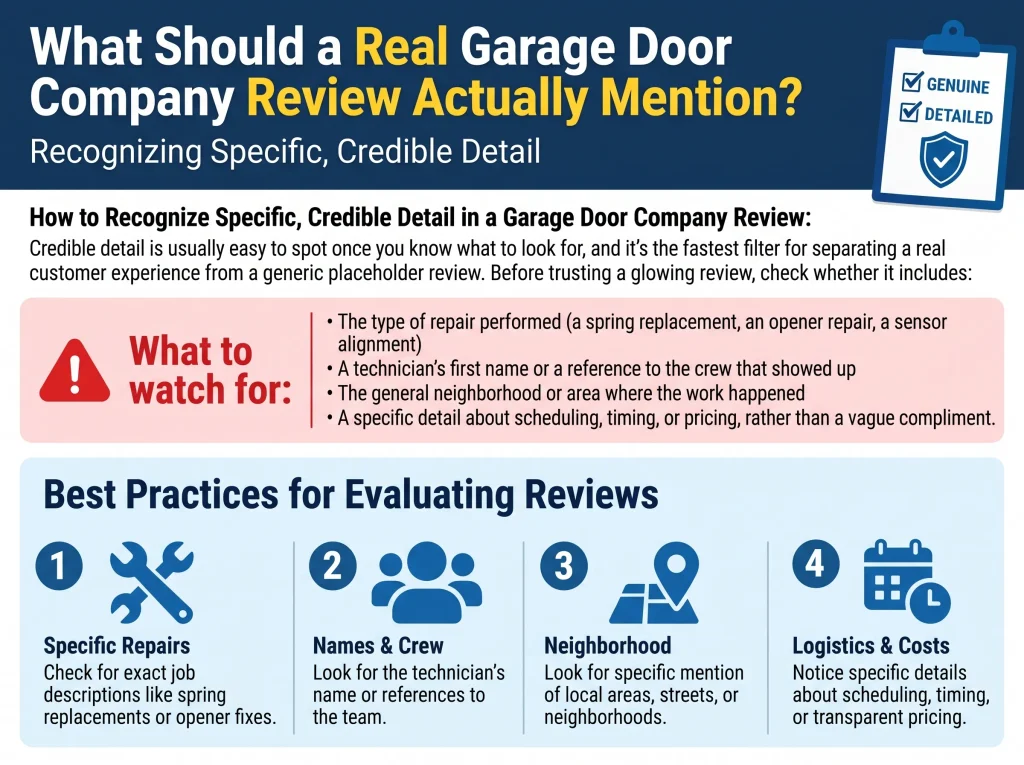
A 4.9-star average tells you almost nothing about whether the company actually showed up on time, fixed the problem, or charged what they quoted. The written review is where the real signal is.
A real review usually mentions something specific: the type of repair, a technician’s first name, the neighborhood, or a detail about the scheduling or pricing. Reviews that could be copy-pasted onto any local business’s page, with nothing specific to garage doors at all, are worth a second look.
Red flag if: Every review reads like generic praise with no mention of the actual service performed.
How to Recognize Specific, Credible Detail in a Garage Door Company Review
Credible detail is usually easy to spot once you know what to look for, and it’s the fastest filter for separating a real customer experience from a generic placeholder review.
Before trusting a glowing review, check whether it includes:
- The type of repair performed (a spring replacement, an opener repair, a sensor alignment)
- A technician’s first name or a reference to the crew that showed up
- The general neighborhood or area where the work happened
- A specific detail about scheduling, timing, or pricing, rather than a vague compliment
The same demand for specifics applies to licensing and insurance, which we cover in How Do I Verify a Garage Door Company Is Licensed and Insured? 5 Things to Check.
2. Why Do Fake Garage Door Company Reviews Often Appear in Clusters?
One of the clearest signs a review might not be genuine is a large number of reviews posted within a short period of time, rather than spread out naturally. A company that’s been in business for years but suddenly has a spike of twenty five-star reviews in one week has a pattern worth questioning.
Reviews get purchased or generated in batches, so they tend to land on a platform around the same time rather than trickling in the way real customer feedback naturally does over months or years.
Red flag if: The review timeline shows a sharp, unexplained spike rather than a steady trickle over time.
How to Check the Posting Timeline on a Garage Door Company’s Reviews
Most platforms make this easy to check in under a minute once you know where to look.
To spot a cluster:
- Sort reviews by “newest” on Google or Yelp and scan the dates
- Look for a large gap between long stretches of normal activity and a sudden spike
- Compare the timing of any spike against a major promotion, hiring push, or ownership change, since a legitimate explanation should be findable
- Take extra notice if a spike appears shortly after a wave of negative press or complaints, since that timing can indicate an attempt to bury bad news
3. How Do I Check If a Reviewer’s Profile Is Real?
Most platforms let you click into a reviewer’s profile and see their other activity. A reviewer with a long history of reviewing restaurants, retailers, and other local businesses is more credible than an account that exists solely to leave one review, ever.
Click on the reviewer’s name or profile. If the account was created recently, has no other reviews, and no other activity, treat that single review with more skepticism than one from an established local reviewer.
Red flag if: Several of a company’s most glowing reviews come from accounts with no other review history at all.
What a Genuine Reviewer’s Profile Usually Shows
A real reviewer’s profile tends to look lived-in rather than freshly created for a single purpose.
Look for:
- A review history that spans multiple, unrelated local businesses
- A profile photo or real name, rather than initials with no other identifying detail
- An account age that’s noticeably older than the review itself
- A mix of ratings across their own review history, not exclusively five-star praise for every business they’ve ever mentioned
4. Why Do Fake Reviews Often Sound So Similar to Each Other?
When several reviews use strikingly similar sentence structure, the same unusual phrase, or an oddly specific compliment repeated word-for-word, that’s a stronger signal of coordinated or purchased reviews than any single review on its own.
Reviews generated or written in batches, whether by the same person, an incentivized group, or AI tools, tend to reuse phrasing and structure because they’re coming from a limited number of sources rather than genuinely independent customers.
Red flag if: Multiple “different” reviewers use nearly identical language to describe their experience.
How to Spot Repeated Phrasing Across a Garage Door Company’s Reviews
This pattern is easier to catch than it sounds once you’re reading several reviews back to back instead of skimming one at a time.
Watch for:
- Identical or near-identical sentence structure across reviews from different names
- The same unusual adjective or turn of phrase showing up more than once
- Reviews posted close together in time that also happen to read alike
- Praise that sounds like it was written from the company’s point of view rather than a customer’s
That same demand for specifics is worth applying to pricing too, which is exactly what we cover in Why Do Garage Door Repair Quotes Vary So Much Between Companies? 6 Pricing Red Flags to Watch.
The International Door Association’s post on garage door scam awareness flags this kind of clustered review activity as a common tactic used by less scrupulous operators.
5. Which Platforms Should I Check Before Trusting a Garage Door Company’s Reviews?
A company that looks flawless on one review platform but has a noticeably different reputation on another (or no presence at all elsewhere) is worth a closer look. Real customer feedback tends to show up in more than one place over time.
Check Google, the Better Business Bureau, and a local platform like Nextdoor if it’s active in your area. Consistency across platforms is a stronger signal than a great score on just one.
Red flag if: The company’s reputation is dramatically different from one review platform to the next.
How to Cross-Check a Garage Door Company’s Reputation Across Platforms
A few extra minutes spent comparing platforms can surface a very different picture than the one shown on a single page.
Check reputation across:
- Google Business Profile, since it’s the most commonly checked and hardest to fully curate
- The Better Business Bureau, which also shows complaint history alongside ratings
- Nextdoor or another local community platform, where neighbors often share direct experience
- Any noticeable mismatch in tone, detail, or rating between platforms, which is worth asking the company about directly
The International Door Association’s scam awareness guidance recommends reporting fraudulent businesses directly to Google and the BBB, which is exactly why those platforms are worth checking first.
If you want to see how checking reviews fits alongside licensing, pricing, and warranty checks, read How to Choose a Trustworthy Garage Door Company.
Trust the Pattern, Not the Number
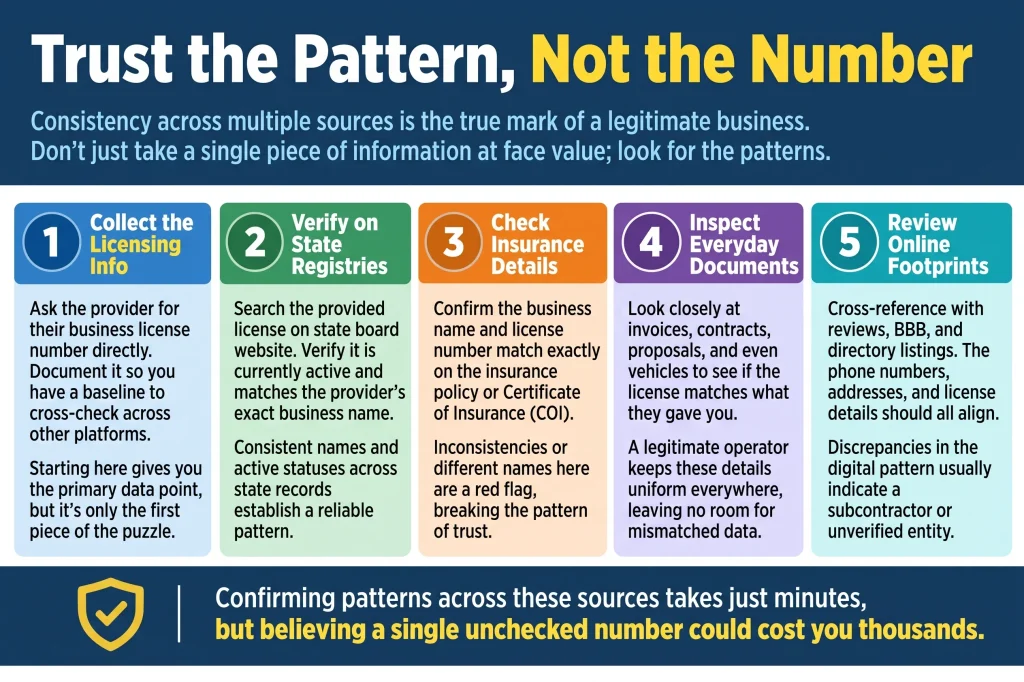
A star rating is the easiest part of a review profile to fake and the least useful thing to judge a company by on its own. Anyone can buy a five-star average. What’s much harder to manufacture is a consistent pattern: reviews that arrive steadily over time, come from real accounts with real history, use language that actually varies from one customer to the next, and hold up the same way across more than one platform.
That pattern is where the truth lives, and it takes the same few minutes to check as scrolling past the star rating at the top of the page. All About Doors technicians serving Glen Burnie, MD encourage customers to check reviews across platforms, not just one, before booking, and to spend those few minutes before you book rather than after a technician is already in your driveway. Contact us or give us a call today.
Frequently Asked Questions
Can a garage door company pay to have negative reviews removed?
Reputable review platforms don't allow businesses to pay for removal of genuine negative reviews. A company claiming they can make a real negative review disappear for a fee is a separate red flag on its own.
Should I trust a garage door company that only has reviews on its own website?
Reviews should be checkable off the company's own site. In our experience, third-party platforms are harder to fake at scale than a testimonials page a company controls entirely.
How many reviews should a trustworthy garage door company have?
There's no fixed number, since it depends on how long the company has been operating and how many customers they serve. A steady, gradual pattern of reviews over time matters more than hitting a specific count.
Do fake reviews only help a company, or can they also hurt competitors?
Both happen. Fake negative reviews are sometimes used to damage a competitor, so an unusually harsh review with no specific detail deserves the same scrutiny as an unusually glowing one.
If a garage door company has a low rating on one platform but a high rating on another, which should I trust?
Neither on its own. Look at the actual review text on both platforms and weigh the detail and consistency, rather than picking whichever number is more convenient.
Can I tell if a review was written by an AI tool instead of a real customer?
It's difficult to say with certainty, but overly polished, generic language with no specific detail about the repair is a common feature of both AI-generated and otherwise inauthentic reviews.
Should I ask a garage door company directly about a suspicious review pattern?
You can, and how they respond tells you something. A company confident in its reputation will usually explain the pattern rather than getting defensive or dismissive.
Is it a red flag if a garage door company asks happy customers to leave reviews?
No, that's a normal and honest practice. The concern is incentivizing or writing reviews on a customer's behalf, not simply asking satisfied customers to share their experience.
What should I do if I think a garage door company's reviews are fake?
Rely more heavily on cross-platform checks, licensing verification, and direct references rather than the review count alone, and consider reporting clearly fraudulent reviews to the platform where you found them.


