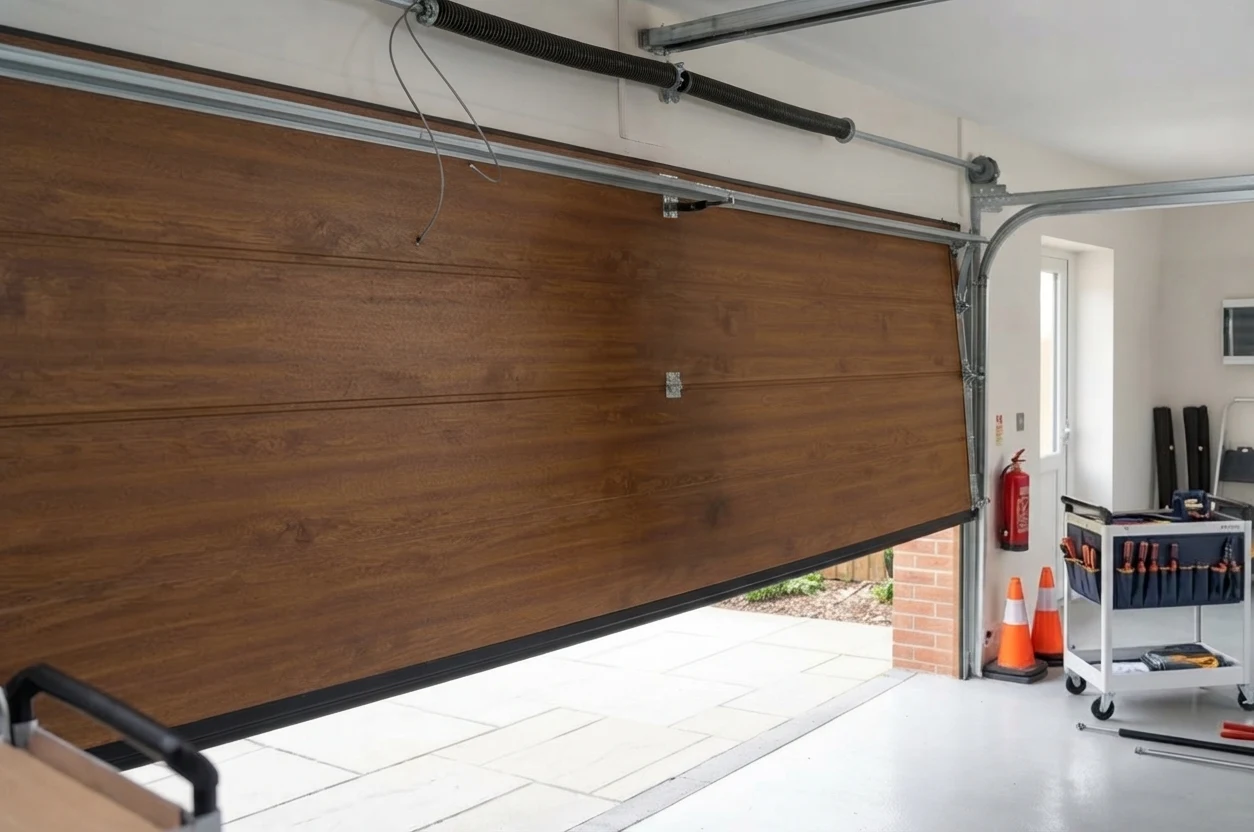
A broken garage door spring usually shows up as a visible gap or separation in the coil, a door that suddenly feels too heavy to lift, a loud bang from the garage, or a door that hangs crooked on one side. If you see any of these, stop using the door by hand and don’t try to force the opener; this calls for garage door repair from a professional who can inspect and replace the spring.
Key Takeaways
- A snapped torsion spring usually leaves a visible gap in the coil, often near the center of the shaft above the door.
- A loud bang or gunshot-like noise is one of the most common ways homeowners first notice a broken spring.
- A door that suddenly feels 30-40 lbs heavier, or won’t budge at all, is a classic sign the spring has failed.
- A door that hangs crooked, with one side higher than the other, points to one spring on a two-spring system breaking.
- Rust, stretching, or visible wear are warning signs a spring is close to failing, even before it fully breaks.
- Never attempt a spring repair yourself; torsion and extension springs are under high tension and can cause serious injury.
Signs at a Glance: Cause and Urgency
| Sign | What It Usually Means | Urgency |
| Visible gap in the coil | Spring has fully snapped | Emergency, stop using the door |
| Door suddenly feels heavy | Counterbalance is gone; full door weight is unsupported | Emergency, disconnect opener |
| Loud bang heard | Spring snapped under tension | Emergency, inspect before any use |
| Door hangs crooked or uneven | One spring broke on a two-spring system | Emergency, don’t force the opener |
| Rust, stretching, or uneven coil spacing | Spring is worn but hasn’t fully failed yet | Schedule soon, before it snaps |
| Cable near the spring is slack or frayed | Secondary stress from a spring failure | Emergency, cable and spring likely both need replacing |
| Opener strains or door won’t move | Motor is fighting the door’s full weight | Emergency, stop running the opener |
1. There’s a Visible Gap in the Coil
Symptom: You look up at the spring above the garage door and see a clear separation, like the metal coil has been cut, with a gap of an inch or more between the two halves.
Most likely cause: The torsion spring has fully snapped, usually from metal fatigue after thousands of open-close cycles.
Fix steps: This isn’t a DIY fix. Torsion springs store enormous tension and require special winding bars and training to replace safely. Note which side the gap is on (left or right of center) so a technician can quote the job faster.
Call a pro if: You see any gap at all, even a small one. A partially separated spring can fail completely without warning.
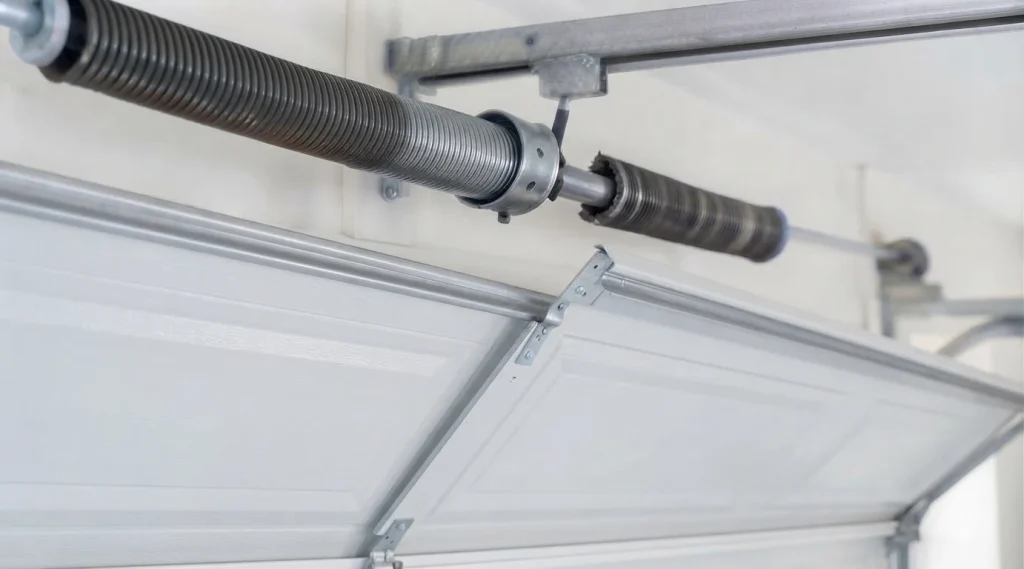
How to Tell if a Garage Door Spring Has Snapped
Look at the horizontal shaft directly above the door, where the spring sits. An intact spring looks like one continuous, tightly wound coil. A snapped spring shows two distinct sections with a visible break point, sometimes with the ends curled slightly outward from the release of tension.
2. The Door Suddenly Feels Extremely Heavy
Symptom: Lifting the door by hand (with the opener disconnected) feels dramatically harder than usual, sometimes too heavy to lift past waist height.
Most likely cause: The spring, which normally counterbalances most of the door’s weight, has broken and is no longer doing its job. The full weight of the door, often 130-400 lbs, is now on your arms or the opener motor.
Fix steps: Don’t force it. If the opener is still trying to lift the door, disconnect it (pull the manual release cord) so the motor doesn’t burn out working against dead weight.
Call a pro if: The door feels unusually heavy and you haven’t already confirmed a visible spring break; a technician can diagnose whether it’s the spring, cables, or rollers.
Why Does a Garage Door Get So Heavy When the Spring Breaks
The spring’s entire job is to offset the door’s weight so the opener only has to manage a few pounds of resistance instead of hundreds. Once it breaks, that counterbalance disappears, and the true weight of the door hits both the opener and anyone trying to lift it by hand.
3. You Heard a Loud Bang
Symptom: A sudden, loud bang, sometimes described as gunshot-like, coming from the garage, often followed by the door not working correctly.
Most likely cause: A torsion or extension spring snapping under tension. The sound comes from the sudden release of stored energy.
Fix steps: Check the spring visually (from a safe distance; don’t stand directly under it) for a gap or displacement. Avoid using the door until it’s inspected.
Call a pro if: You heard the bang. Even if the door still seems to open, a snapped spring puts extra strain on the opener and cables.
How to Fix a Garage Door After a Loud Bang Noise
Don’t attempt to operate the door. Disconnect the opener’s manual release if the door is stuck partway, and schedule a spring inspection and replacement rather than testing the door repeatedly.
If you’re trying to pin down exactly what caused the sound, read our guide, Why Did My Garage Door Make a Loud Bang? 5 Causes of a Snapped Spring, for the full breakdown.
4. The Door Hangs Crooked or Uneven
Symptom: One side of the door sits noticeably higher than the other, or the door looks tilted when it’s partially open.
Most likely cause: On a two-spring system, one spring has broken while the other is still intact, pulling the door unevenly.
Fix steps: Don’t run the opener repeatedly trying to “fix” the tilt; this can bend tracks or damage rollers. Leave the door where it is.
Call a pro if: The door is visibly uneven. This should be treated with the same urgency as a full stop; one working spring can’t safely support the door alone.
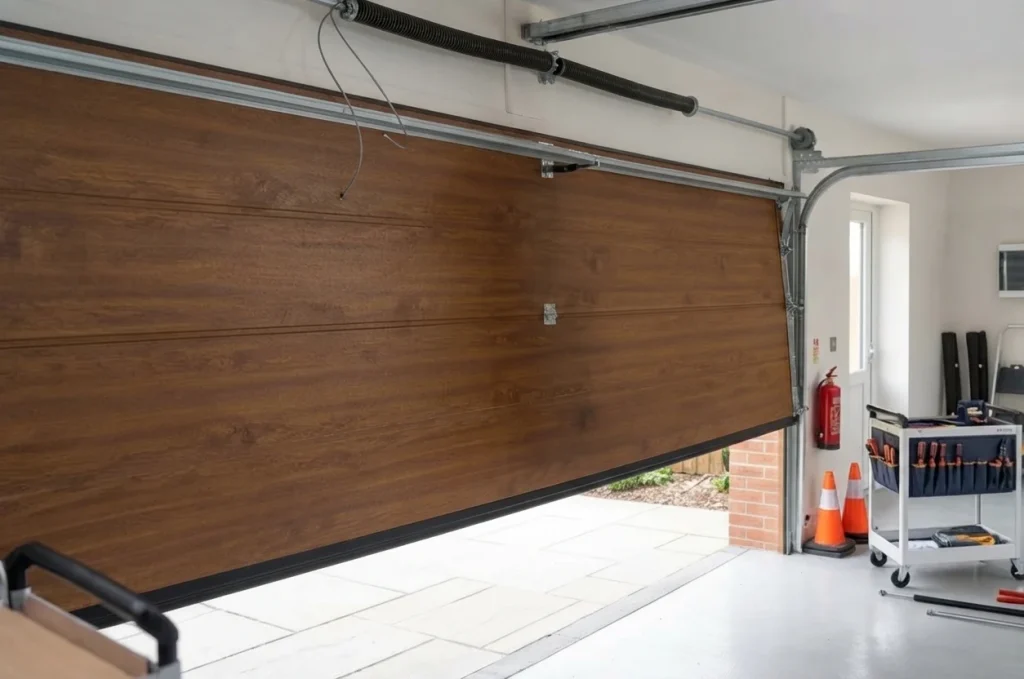
Why Is My Garage Door Crooked on One Side
A two-spring system relies on both springs sharing the load evenly. If one breaks, the working spring takes over unevenly, causing the door to rack, tilt, or bind in the tracks, sometimes damaging the tracks or rollers if it’s operated in this state.
If your door is hanging crooked, read our guide, Why Is My Garage Door Crooked or Uneven? 4 Reasons a Spring Is to Blame, to narrow down the exact cause.
5. The Spring Looks Rusted, Stretched, or Worn
Symptom: The coil looks stretched out with visible gaps between wraps, shows heavy rust, or has flattened spots.
Most likely cause: Age and metal fatigue. Most torsion springs are rated for 10,000-15,000 cycles (roughly 7-12 years of average use) before they’re due to fail.
Fix steps: This is a “before it breaks” warning sign rather than a break itself. Schedule a replacement proactively rather than waiting for a full snap, and consider adding annual garage door maintenance to your routine to catch wear like this earlier.
Call a pro if: You notice rust, stretching, or uneven coil spacing; replacing a visibly worn spring is far cheaper and safer than an emergency call after it fails. Torsion springs are considered one of the highest-tension components in a home, and the Door and Access Systems Manufacturers Association’s safety guidance recommends leaving spring inspection and replacement to a trained technician rather than attempting it yourself.
How to Tell a Garage Door Spring Is About to Break
Watch for a spring that looks stretched (gaps between coils that weren’t there before), shows surface rust, or looks slightly different in diameter from a matching spring on the other side.
6. The Cable Near the Spring Looks Slack or Frayed
Symptom: The cable running alongside the spring assembly looks loose, kinked, or frayed instead of taut.
Most likely cause: A broken spring often puts abnormal stress on the cable and drum system, causing visible slack or fraying.
Fix steps: Don’t touch or attempt to re-tension the cable. It’s under load and can snap.
Call a pro if: You see any slack, kinking, or frayed strands. Cables and springs are usually replaced together in this situation.
Why Is My Garage Door Cable Loose or Frayed
Cables and springs work as a system. When a spring breaks, the sudden change in tension can cause the cable to jump the drum, fray against the track, or hang slack, which is a strong secondary confirmation that the spring has failed.
7. The Opener Motor Strains or the Door Won’t Move at All
Symptom: The opener runs, but the door barely moves, makes a straining/grinding sound, or doesn’t move at all.
Most likely cause: With the spring gone, the opener motor (designed to move a counterbalanced door) is trying to lift the door’s full weight and can’t.
Fix steps: Stop trying to run the opener. Repeated attempts can burn out the motor or strip the gears.
Call a pro if: The opener is straining. This is often how homeowners discover a broken spring in the first place.
If your door won’t open at all, read our guide, Why Won’t My Garage Door Open? 6 Signs It’s a Broken Spring, for the full list of signs.
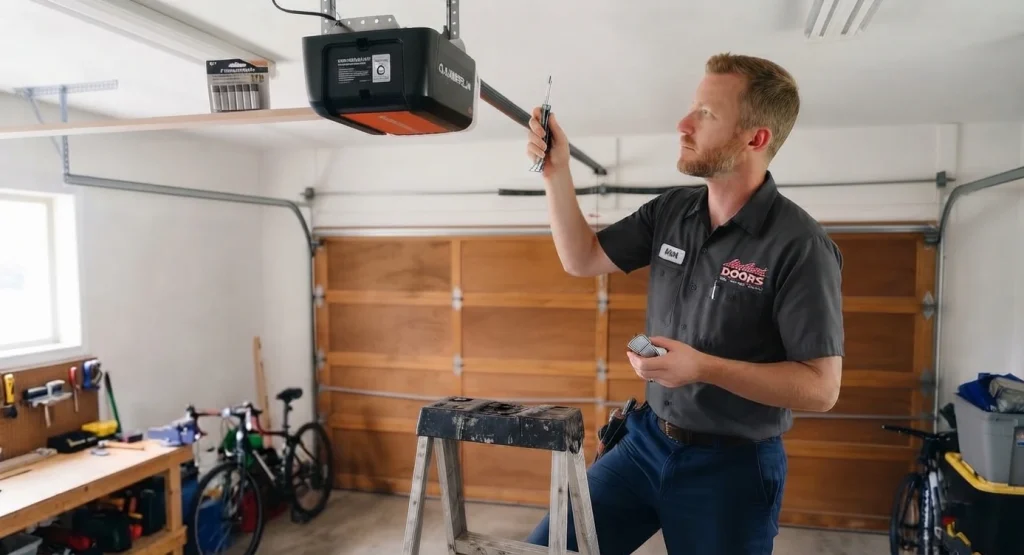
How to Fix a Garage Door Opener That Won’t Lift the Door
Disconnect the opener using the manual release cord so it stops fighting the dead weight, then schedule spring service. Continuing to run the motor against a broken spring is one of the most common ways homeowners turn a spring repair into an opener replacement too.
Spotted One of These Signs? Here’s What to Do Next
A broken garage door spring is almost always identifiable by one or more of the signs above: a visible gap in the coil, sudden heaviness, a loud bang, an uneven door, or a straining opener. None of these are safe to fix yourself; torsion and extension springs are under enough tension to cause serious injury.
All About Doors offers same-day spring inspection and replacement for homeowners in the Glen Burnie, MD area. Contact us or give us a call for same-day service if your door won’t open.
Frequently Asked Questions
If the door is already open and the spring breaks, yes, you can typically back out, but don’t run the door closed afterward. One of our most common calls is homeowners who kept trying the opener after a break and ended up needing opener repair on top of the spring.
No. Without the spring’s counterbalance, the door’s full weight is unsupported, and it can drop suddenly. Leave it exactly where it is and call for service.
Costs vary based on spring type (torsion vs. extension), door size, and whether one or both springs need replacing. In our experience, replacing both springs at once (even if only one broke) is usually the better value, since the second is typically close behind on wear.
Torsion springs are usually installed as a matched pair and wear at a similar rate. Our rule of thumb from the field: if one goes, budget for the second soon after, even if it hasn’t visibly failed yet.
Yes, this is one of the most common secondary repairs we see. If the opener keeps trying to lift the door after the spring breaks, the motor and gears take on stress they weren’t designed for.
Most torsion springs are rated for 10,000-15,000 open-close cycles, which works out to roughly 7-12 years for an average household. Heavier doors or more frequent use shorten that window.
Often, yes. A working remote with a door that won’t budge (or moves very slowly) is one of the more common patterns we see with a failed spring, since the opener’s electronics are unaffected even though the mechanical lift is compromised.
It can seem sudden, but in our experience most springs show some warning first: rust, stretching, or a slight change in how the door sounds or moves in the weeks before a full break. It’s just easy to miss if you’re not looking for it.
Technically yes, but we generally advise against it for two-spring systems. Mismatched spring age can cause uneven lifting and put more strain on the newer spring. As The Spruce’s guide to replacing garage door springs notes, the job involves working under high tension, which is part of why we recommend a trained technician handle it rather than a DIY approach.
Most spring replacements are same-day or next-day jobs once parts are confirmed. We offer same-day service for broken springs in the Glen Burnie, MD area in most cases.